



Virtual Assistant Statistics 2025: Global Market, Demand, and Usage Trends
In the digital age, platforms and technologies that streamline communication, entertainment, and productivity have reshaped how we live and work.
TikTok, the short-form video powerhouse, has captured global attention with its rapid growth, diverse user base, and cultural influence, while virtual assistants-both human and AI-driven-have transformed the way businesses and individuals manage tasks and information.
Table of Contents
From exploring who uses TikTok and what types of content dominate the platform to understanding the rising demand for virtual assistants and voice-activated technology, this comprehensive guide dives deep into the latest trends, statistics, and insights.
By examining demographics, engagement rates, regional distributions, and the skills that make virtual assistants indispensable, readers gain a holistic view of the evolving digital landscape.
How many virtual assistants are there in the world?
“Virtual assistant” can mean two very different things, so the honest answer depends on which one you mean: AI-powered digital assistants (Siri, Alexa, Google Assistant and the like) or human remote “virtual assistants” (freelancers who do admin, social, and other remote tasks).
On the digital side, estimates vary by metric – device count, active user count, and per-person usage all tell different stories.
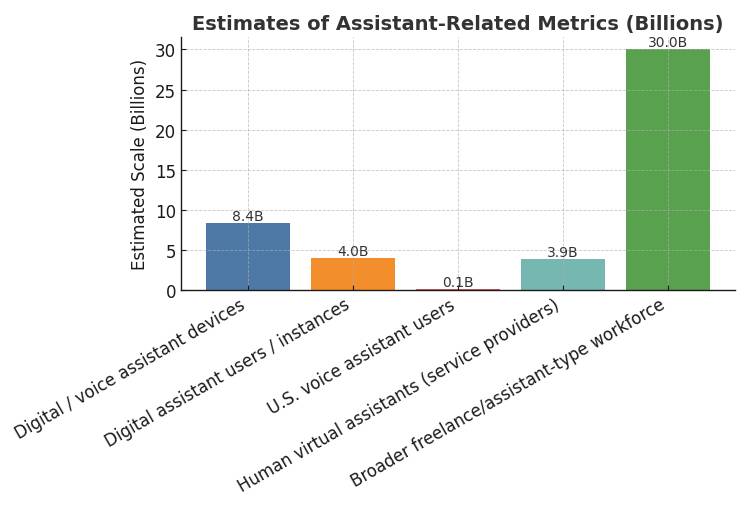
Some industry trackers put the number of voice-enabled devices (smartphones, smart speakers, wearables with assistants) at roughly 8.4 billion devices worldwide by 2024 – in other words, there are now more assistant-capable devices than people on the planet.
User counts are messier: earlier research showed about 1.8 billion users of digital assistants in 2021, while other aggregations and marketing summaries suggest the broader “digital assistant” footprint (counting every active assistant instance or account) can be in the multiple billions – some sources quote figures around 4 billion in various contexts, depending on whether they count installs, active devices, or unique users. In specific markets the numbers are easier to peg: for example, U.S. voice assistant user projections sit in the ~150 million-plus range with steady, single-digit growth year to year.
By contrast, the human virtual assistant workforce is far smaller but still substantial: market reports estimated roughly 3.9 million individuals working as virtual assistant service providers around 2020, with projections (depending on definitions and platform counts) showing growth into the mid-millions by the late 2020s; if you broaden the definition to include all remote freelancers doing assistant-type work, some industry summaries point to tens of millions across freelancing marketplaces.
So – short version without the hype: if you mean AI/voice assistants, count in the billions of devices and multiple-billion instances/users depending on your metric; if you mean human virtual assistants, count in the low-to-mid millions (or much higher if you fold in the entire freelance ecosystem). Below is a compact table summarizing those headline ranges for easy reading.
| Category | Typical headline estimate (range) |
| Digital / voice assistant devices | ~8.4 billion devices (2024 estimate) |
| Digital assistant users / instances | ~1.8 billion (2021) up to ~4+ billion (varies by metric) |
| U.S. voice assistant users | ~150+ million (market projections) |
| Human virtual assistants (service providers) | ~3.9 million (2020 estimate); projections to mid-millions by late-2020s |
| Broader freelance/assistant-type workforce | Potentially tens of millions if counting all remote freelancers on major platforms |
Is there a high demand for virtual assistants?
The demand for virtual assistants (VAs) has surged dramatically in recent years, driven by technological advancements and shifting work dynamics.
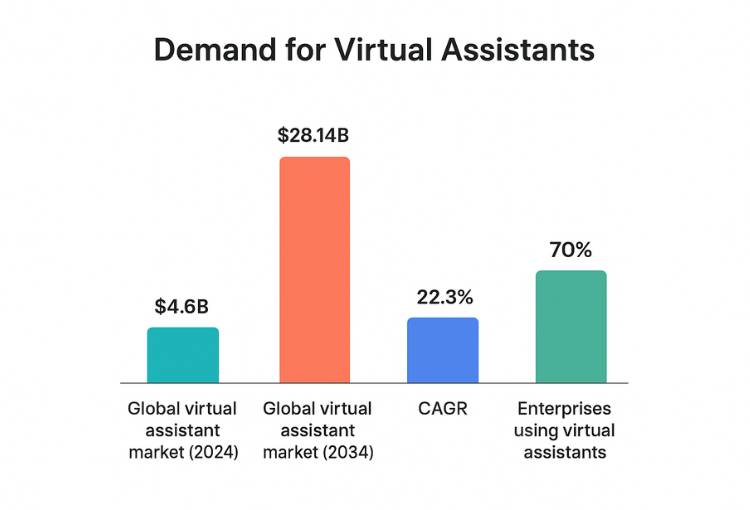
In 2024, the global virtual assistant market was valued at approximately $4.6 billion and is projected to reach nearly $28.14 billion by 2034, reflecting a compound annual growth rate (CAGR) of 22.3%.
This growth is fueled by the increasing adoption of artificial intelligence (AI) and natural language processing (NLP), which enhance the capabilities of virtual assistants, making them more efficient and user-friendly.
The rise of remote work has further accelerated the demand for VAs. In 2024, job postings for virtual assistants increased by 35%, indicating a significant shift towards outsourcing administrative and support tasks to remote professionals.
This trend is not limited to administrative roles; VAs are now sought after for specialized services such as social media management, content creation, data analysis, and customer support.
Enterprises are increasingly integrating virtual assistants into their operations to enhance efficiency and reduce costs. Approximately 70% of medium to large enterprises utilize virtual assistants to streamline various functions, from customer service to data management.
This widespread adoption underscores the growing recognition of VAs as valuable assets in the modern business landscape.
The healthcare sector, in particular, has experienced a notable uptick in the use of virtual assistants.
Companies like Global Medical Virtual Assistants (GMVA) have reported a revenue growth of over 1,000% from 2021 to 2024, highlighting the increasing reliance on VAs to handle administrative tasks such as insurance verification and patient scheduling.
In summary, the virtual assistant industry is experiencing robust growth, driven by technological innovations, the shift towards remote work, and the increasing recognition of VAs’ value across various sectors.
As businesses continue to seek cost-effective and efficient solutions, the demand for virtual assistants is expected to remain strong in the foreseeable future.
What are the different types of virtual assistants?
Virtual assistants (VAs) come in various types, each designed to handle specific tasks that cater to different business needs. For instance, administrative VAs manage scheduling, email correspondence, and data entry, ensuring smooth day-to-day operations.
Customer service VAs, on the other hand, handle client inquiries, complaints, and support through various channels like phone, chat, or email.
E-commerce VAs assist online store owners by managing product listings, processing orders, and handling customer queries. Social media VAs focus on creating and scheduling content, engaging with followers, and analyzing performance metrics to enhance online presence.
Technical VAs possess IT skills to manage website updates, troubleshoot issues, and provide basic coding support. Specialized VAs cater to niche industries; for example, healthcare VAs manage patient appointments and medical records, while legal VAs assist with document preparation and legal research.
Real estate VAs support agents by handling property listings, client communications, and transaction coordination. Additionally, personal VAs help individuals with tasks like travel arrangements, calendar management, and personal shopping.
These diverse roles highlight the versatility of virtual assistants in addressing a wide range of tasks across different sectors.
Which is the most popular virtual assistant?
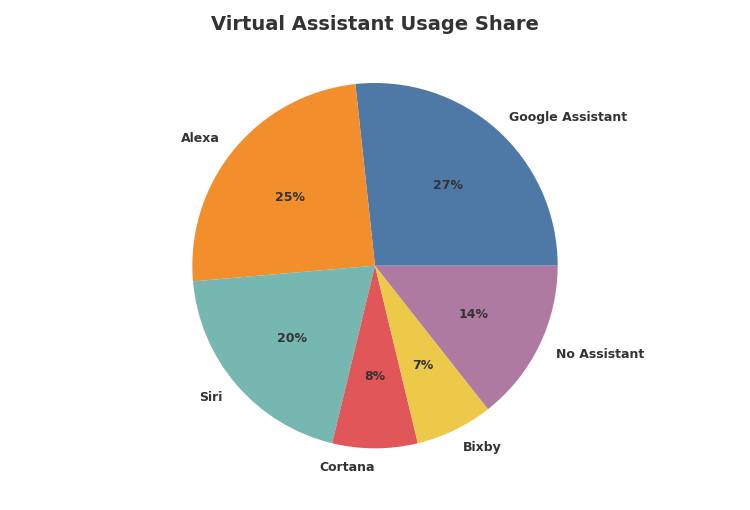
Google Assistant currently holds the top spot in the virtual assistant market, with 39% of users indicating its usage. Alexa by Amazon follows closely with 36%, while Siri by Apple is used by 29% of respondents.
Other virtual assistants, such as Microsoft’s Cortana and Samsung’s Bixby, have smaller user bases, with 11% and 10% usage rates, respectively. Despite the dominance of these major players, 21% of respondents report not using any of these virtual assistants.
The global virtual assistant market is experiencing significant growth, projected to reach USD 4.6 billion in 2025 and expand to nearly USD 28.14 billion by 2034, reflecting a strong compound annual growth rate (CAGR) of 22.3% over the period.
This growth is driven by advancements in artificial intelligence (AI) and natural language processing (NLP), which enhance the capabilities of virtual assistants in understanding and responding to user queries.
However, privacy concerns remain a challenge, with over 45% of surveyed users expressing hesitation in sharing sensitive data with virtual assistants.
In terms of industry applications, virtual assistants are widely utilized across various sectors. Approximately 37.7% of businesses employ virtual assistants for administrative tasks, 20.5% for marketing purposes, and 14% for sales and prospecting activities.
These digital aids contribute to streamlined operations, improved efficiency, and cost savings for organizations.
Regional adoption varies, with North America leading the market, accounting for more than 40% of the global share. This is attributed to strong adoption in sectors such as healthcare, finance, and retail, as well as the presence of major technology companies in the region.
Emerging markets in Asia-Pacific, Latin America, and the Middle East and Africa are also witnessing increased demand for virtual assistant services, driven by rapid economic development and growing internet penetration.
Overall, the virtual assistant market is poised for continued expansion, with technological advancements, industry adoption, and regional growth contributing to its upward trajectory.
Who uses a virtual assistant?
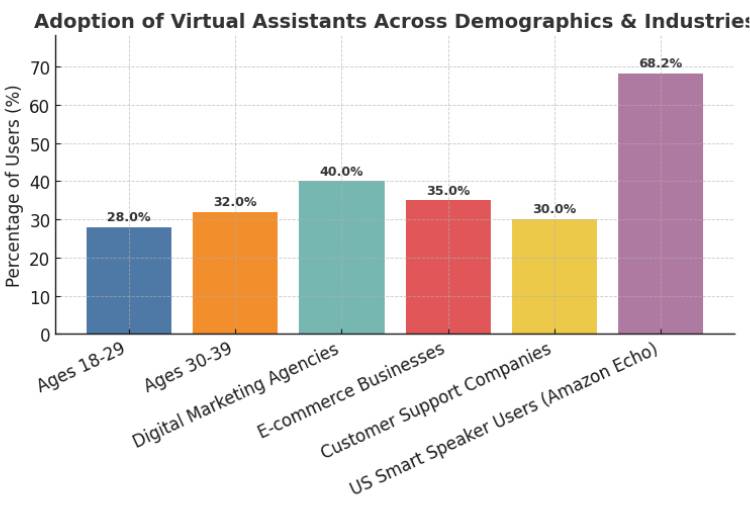
Virtual assistants are increasingly popular among a diverse range of users, spanning various age groups, professions, and regions. Among individuals aged 18 to 29, 28% actively employ virtual assistants, showcasing their prevalence among younger demographics.
Similarly, in the 30 to 39-year bracket, 32% of respondents engage with virtual assistants, indicating a continued usage trend. This suggests that virtual assistants are particularly popular among younger individuals.
In the professional realm, virtual assistants are widely utilized across different industries. For instance, 40% of digital marketing agencies rely on virtual assistants for campaign management, while 35% of e-commerce businesses use them for product research.
Additionally, 30% of companies in customer support employ virtual assistants to handle their daily operations. This highlights the growing trend of businesses leveraging virtual assistants to enhance efficiency and reduce costs.
Furthermore, the adoption of virtual assistants is not limited to specific regions. In the United States, approximately 68.2% of smart speaker users prefer Amazon Echo, a device powered by Alexa, indicating a significant user base for virtual assistants in the country.
This widespread usage underscores the global appeal and utility of virtual assistants in various aspects of daily life and business operations.
Overall, the diverse range of users-from young individuals to professionals across different industries and regions-demonstrates the broad and growing adoption of virtual assistants worldwide.
Which country has the most virtual assistants?
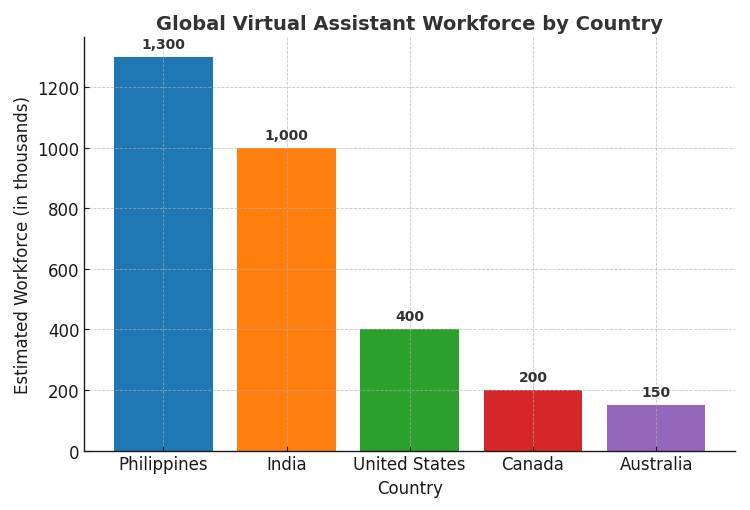
The Philippines stands out as a leading hub for virtual assistants, boasting a robust business process outsourcing (BPO) industry that contributes significantly to its economy.
The country is home to over 1.3 million BPO employees, with a substantial portion engaged in virtual assistant roles.
Filipino virtual assistants are renowned for their proficiency in English, strong work ethic, and cultural alignment with Western business practices, making them highly sought after by companies in North America, Europe, and Australia.
The Philippines’ dominance in the virtual assistant industry is further underscored by its strategic location in the Asia-Pacific region, which facilitates convenient time zone overlaps with key international markets.
India also plays a significant role in the virtual assistant landscape, offering a vast pool of skilled professionals at competitive rates.
The country’s extensive experience in outsourcing services, coupled with its large English-speaking population, positions it as a favorable destination for businesses seeking virtual assistance.
While India’s virtual assistant market is substantial, it is characterized by a diverse range of service offerings, catering to various industries and business needs.
Other countries contributing to the global virtual assistant workforce include the United States, Canada, and Australia. These nations have a well-established remote work culture and a high number of professionals offering virtual assistant services.
However, the scale of their virtual assistant markets is comparatively smaller than that of the Philippines and India.
In summary, while several countries participate in the virtual assistant industry, the Philippines leads in terms of market size and global demand, followed by India with its expansive and diverse service offerings.
What is the target market for virtual assistants?
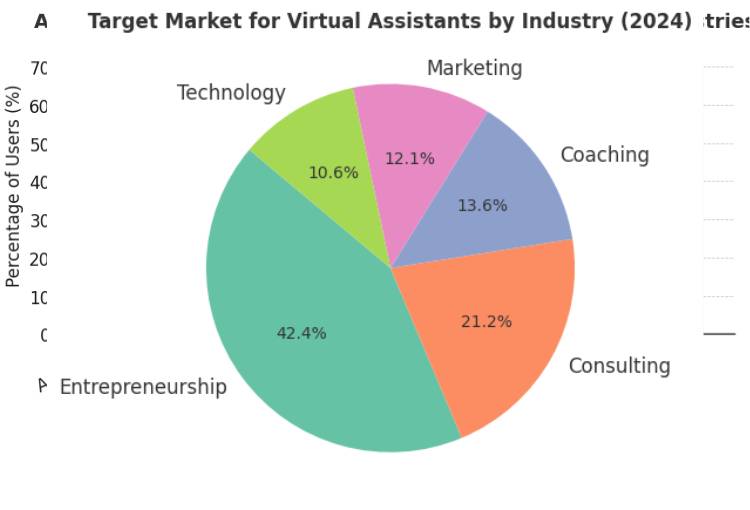
Virtual assistants (VAs) cater to a diverse clientele across various sectors, with their services in high demand among small businesses, entrepreneurs, and professionals seeking to streamline operations and enhance productivity.
In particular, industries such as entrepreneurship (28%), consulting (14%), coaching (9%), marketing (8%), and technology (7%) are significant consumers of VA services.
Small business owners, especially those managing growing enterprises, often require assistance with administrative tasks, customer service, and social media management.
For instance, startups and digital marketing agencies frequently hire VAs to handle scheduling, lead generation, and content creation.
Professionals in fields like law, real estate, and accounting also benefit from VA support. Law firms utilize VAs for document preparation and research, while real estate agents rely on them for client communication and marketing efforts.
Similarly, accounting firms delegate tasks such as data entry and appointment scheduling to VAs.
The rise of remote work has further expanded the VA market. With 99% of remote workers preferring to work remotely at least some of the time, businesses are increasingly turning to VAs to manage administrative tasks, manage projects, and provide customer support from afar.
In summary, the target market for virtual assistants encompasses a wide array of industries and professionals, all seeking efficient solutions to manage their workload and enhance operational efficiency.
What is the most crucial skill for a virtual assistant?
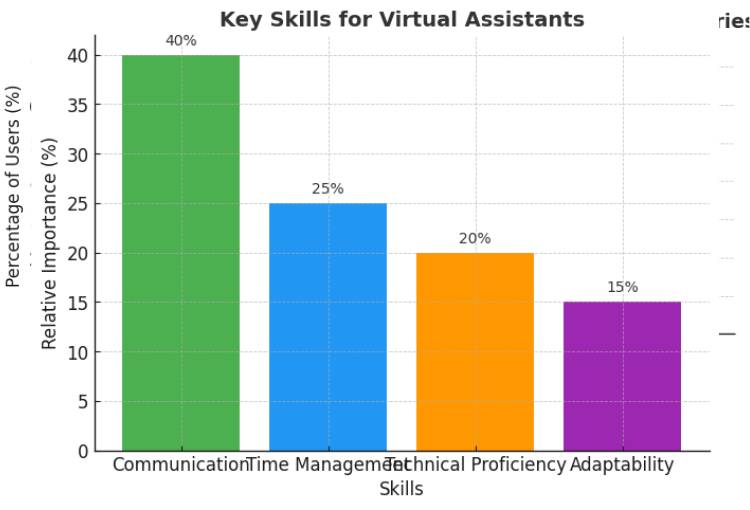
Effective communication stands out as the most crucial skill for a virtual assistant. Whether it’s crafting clear emails, managing client expectations, or coordinating schedules, the ability to convey information accurately and professionally is paramount.
Strong communication fosters trust and ensures that tasks are completed as intended, minimizing misunderstandings and enhancing client satisfaction.
In addition to communication, time management is essential. Virtual assistants often juggle multiple tasks and clients simultaneously. Prioritizing tasks, setting realistic deadlines, and staying organized are key to maintaining productivity and meeting client expectations.
Technical proficiency is another valuable asset. Familiarity with tools like Microsoft Office, Google Workspace, and various project management platforms enables virtual assistants to perform tasks efficiently and collaborate effectively with clients.
Lastly, adaptability is vital. The virtual assistant role can vary greatly depending on the client’s needs. Being open to learning new skills and adjusting to different work styles ensures that virtual assistants can meet diverse client demands and thrive in a dynamic work environment.
How popular are voice assistants?
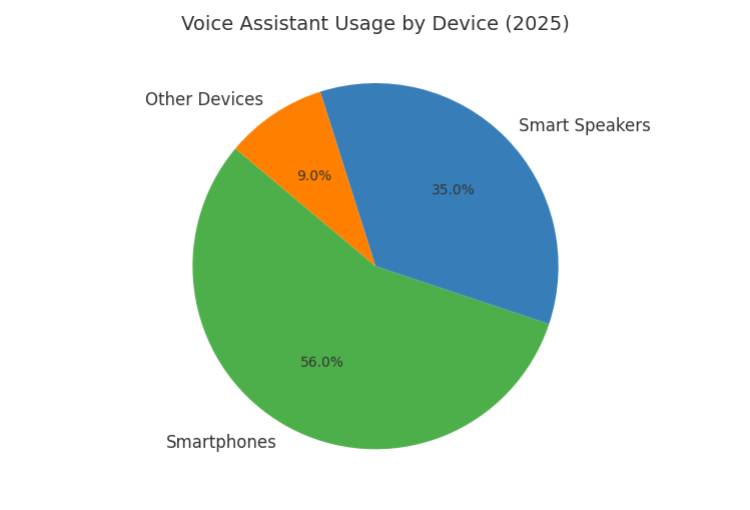
Voice assistants have become increasingly popular, with their adoption growing rapidly across various devices and demographics. As of 2025, there are approximately 8.4 billion voice assistants in use worldwide, surpassing the global population of 8.2 billion.
This surge is partly due to the prevalence of multiple voice-enabled devices per household. In the United States, the number of voice assistant users is expected to reach 153.5 million in 2025, marking a 2.5% increase from the previous year. This steady growth underscores the integration of voice technology into daily life.
The popularity of voice assistants varies across different devices. Smartphones lead in usage, with 56% of voice assistant interactions occurring on these devices. Smart speakers follow at 35%, while other devices such as TVs, cars, and computers account for smaller shares.
This distribution highlights the diverse applications of voice assistants beyond traditional smartphones.
Demographically, younger generations are more inclined to use voice assistants. In the United States, 55.2% of Gen Z and 51.9% of Gen X report using voice assistants monthly, compared to only 31.5% of Baby Boomers.
This trend suggests that familiarity with technology and comfort with voice interactions influence adoption rates.
The increasing popularity of voice assistants is also reflected in their integration into various aspects of daily life, including shopping, entertainment, and smart home management.
As technology continues to advance, the role of voice assistants is expected to expand further, becoming an integral part of the digital experience.
The world of social media and digital assistance continues to evolve at breakneck speed. TikTok’s meteoric rise demonstrates how engaging content, innovation, and algorithmic precision can create a global phenomenon, attracting billions of users while shaping trends and cultural touchpoints.
Simultaneously, the growing demand for virtual assistants, both human and AI-powered, reflects a shift toward efficiency, flexibility, and specialized support in professional and personal spheres.
Together, these developments highlight a broader narrative: technology is not just a tool-it’s a force that connects, entertains, and empowers, shaping the ways people interact with information, content, and each other.
Staying informed about these trends is essential for anyone seeking to understand the current digital landscape and prepare for the innovations yet to come.
Global virtual assistant industry market size and forecast from 2020 to 2025
The industry grew in recent years and will become a multi-billion dollar one in 2025. The demand for virtual assistants is increasing driven by companies’ outsourcing and AI.
Percentage of Businesses Hiring Virtual Assistants (2025)
In 2025, an increasing percentage of businesses have been hiring VAs to offload mundane activities. This allows companies to save money and operate more efficiently, particularly smaller businesses.
What’s the going rate for virtual assistants in 2025?
It depends on the individual and their location. While some assistants are starting out, some are much more seasoned and are capable of charging a premium.
The Percentage of Freelancers Employed as Virtual Assistants
Becoming a virtual assistant is a frequent option for freelancers who are interested in pursuing this as a profession. A large number of virtual assistants utilize this as their primary source of income. In 2025, the number of virtual assistants will continue to rise due to the fact that they are relatively easy to locate and are also very flexible.
Virtual Assistants Usage by Industry in 2025
In 2025, the usage of virtual assistants is expected to be different depending on the industry. It is most popular in e-commerce, real estate, and marketing. The number of other businesses that rely on virtual assistants to get their work done is also expected to rise in 2025.
The Percentage of Outsourced Tasks Handled by Virtual Assistants
In many cases, virtual assistants are responsible for completing the more routine, time-consuming portion of business work. This could involve responding to emails or answering customer inquiries. In 2025, this practice is expected to be very common.
Rise of AI Virtual Assistants versus Human VAs
AI assistants are rising along with human virtual assistants, and the use of AI tools such as chatbots and voice assistants has become standard in 2025. While AI can perform some of the same tasks as human VAs, human VAs are better suited for more complex work. In 2025, both types coexist and complement each other.
Percentage of Entrepreneurs That Employ Virtual Assistants
Entrepreneurs are also a big demographic of the virtual assistant community, as many use VAs to help them run day to day operations and manage the growth of their businesses. In 2025, many founders consider VAs essential. It’s a key part of running lean teams.
Average Number of Clients That a Virtual Assistant Handles
Many virtual assistants will juggle several clients at once. In 2025, juggling several projects is common in this field. It allows VAs to diversify income. Time management becomes an important skill.
How Many Virtual Assistants Work Remotely?
In 2025, virtual assistants are almost entirely remote workers. This means that they offer businesses global reach, hiring flexibility, and convenience.
Virtual Assistant Demand Growth Rate: 2023 to 2025
Demand for VAs has been rising over the last several years. In 2025, this continues to grow as remote work becomes commonplace. More businesses are opting to outsource, and the trend shows no signs of slowing down.
Most Common Tasks That Get Outsourced to VAs
While tasks may change over time, in 2025, VAs still handle many inbox tasks like sorting email and data entry, as well as social media scheduling.
Percentage of Businesses Using VAs for Customer Support
Customer support remains one of the primary applications of VAs and they can answer questions and handle communication. With VAs taking on customer service roles in 2025. They can increase the speed of their responses to customer inquiries.
Virtual Assistant Usage in E-commerce (2025)
VAs are especially prevalent in the E-commerce space and they assist with managing orders, providing customer support and managing product listings. In 2025, this one of the most popular VA use cases, allowing businesses to scale their online operations.
What Percentage of Virtual Assistants Specialize in Certain Niches?
The number of VAs specializing in a specific niche is growing, and as we approach 2025, this is going to be the biggest trend in the industry. Why does this matter? VAs that can specialize in certain skills or industries are more in demand, and therefore, can charge higher rates. This can help you get a better fit for your specific business needs.
How much Time Does Hiring a Virtual Assistant Save?
Businesses save time by outsourcing various tasks they don’t have the skills or resources to handle themselves. In 2025, businesses can expect to save hours per week with the help of a VA, leaving more time for the most impactful tasks.
Percentage of Startups Using Virtual Assistants
Due to their lean teams and minimal funding, startups often make use of virtual assistants in order to increase efficiency rather than bring on full-time employees. As we go into 2025, many small businesses in the US make use of VAs, which has made virtual assistance very popular due to its lower cost of operation.
Virtual Assistant Platforms and Marketplaces Growth
A number of new virtual assistant platforms and marketplaces were started to connect VAs with clients. Websites like Fiverr and Freelancer are very popular. As we go into 2025, these websites have a wide audience in order to recruit VAs for clients. The sites are growing because of the gig economy.
Percentage of Businesses Using Long-Term VA Contracts
Many businesses hire VAs on an ongoing basis rather than on a one-off basis. As we go into 2025, long-term engagements between VAs and businesses become more common. It brings stability to both sides of a working relationship. This leads to a more efficient working relationship as well.
Virtual Assistant Skills in Highest Demand (2025)
There are certain VA skills that businesses need more than others, such as digital marketing, bookkeeping, and automation. As we go into 2025, a lot of demand for tech-savvy VA skills have been generated. Certain skills are more valuable when it comes to the pay for VAs.
Percentage of VAs leveraging AI
AI tools are increasingly being used by VAs to streamline their work processes. Using AI tools for things like writing, research, and automation, can help VAs do more of their job duties. We predict that in 2025, AI will be a part of every VA’s skill set because it has been shown to make workers more efficient and productive.
Proportion of VAs by gender
There is a gender disparity in the virtual assistant profession. In 2025, most VAs will be female, but the virtual assistant pool is becoming more diverse. As people from different backgrounds begin to seek flexible and remote jobs, virtual assistant work is becoming more popular.
What Percentage of VAs Offer Multi-Skill Services?
A great number of VAs provide several different services, not just one. In 2025, multi-skilled VAs will be highly sought after. They are more in-demand, because of their flexibility and their ability to increase income.
What Percentage of VAs Are Used for Content Creation?
Content creation is an emerging area for VAs. VAs are used for various content-related tasks such as writing and content management. In 2025, this particular use case for virtual assistance is expanding, providing support in a variety of content creation and digital marketing tasks.
Future Outlook: Growth Projection of Virtual Assistant Industry by 2030
Looking to the future, it is anticipated that the virtual assistant industry will continue to grow. It will grow thanks to technological advancements and increased adoption of remote work. By 2030, the demand for virtual assistants is expected to increase further. The use case for virtual assistance will continue to evolve in the years to come.
Conclusions
Data shows that virtual assistants are rapidly becoming integral to modern business, and the rising need for these assistants to provide operational support and facilitate business expansion can be attributed to a number of factors such as the desire to find more flexible and cost-effective working arrangements.
Additionally, virtual assistant roles and jobs are changing, as new job categories and qualifications are required, while technology is further evolving virtual assistant jobs and duties, thus making them easier and consequently, increasing the overall demand.
There will be an increase in businesses in the future, thereby presenting further opportunities in different business sectors for virtual assistant services. What is more, since the concept of remote working is gaining ground, companies are seeking to enhance productivity with virtual assistants in place.
All these points lead to a promising outlook for the future of the virtual assistant industry as more companies utilize virtual assistants to scale their businesses.
Human or AI virtual assistants, the demand for virtual assistants is going to be persistent since an increasing number of businesses are going to use virtual assistants as an integral component of their daily functioning.
What is your reaction?