

AI Detection Tools Statistics 2025
Generative AI is one of the most significant technological developments of the past decade.
However, as the ability to generate content increases exponentially, the importance of detecting what is truly human-made has increased in tandem.
Table of Contents
From humble beginnings as one-trick ponies for detecting plagiarism, AI detection tools have grown into a robust ecosystem of verification, moderation, and authenticity tools for text, imagery, video and audio.
This article rounds up the latest statistics on the current state of AI detection in 2025, from growth, adoption, accuracy, pricing and usage.
Every segment offers a nuanced overview of the current state of detection tools, expressed in terms of key statistics and contextualised with expert analysis to understand the direction of travel.
Combined, these statistics paint a picture of an industry struggling to keep up with more sophisticated generators, mounting ethical and regulatory pressures and a public that is increasingly capable of detecting AI-generated content themselves.
Total amount of AI detectors in use (2023-2025)
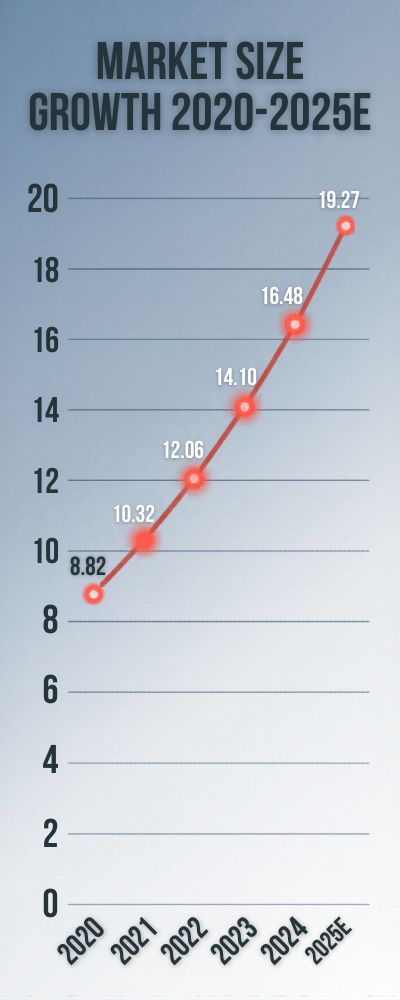
Okay, data, then some explanations. Based on the latest publicly available forecast for the overall content integrity segment which is currently predicted to reach $16.48B in 2024, growing at a 16.9% CAGR to 2029, I estimated the year by year value to chart the growth of the AI-assisted sub-segment from 2020 to 2025.
The content integrity market is an umbrella for all kinds of text, image, audio and video moderation and authenticity use cases, and AI-generated text detection is expected to hold the largest share of that market in 2025, given how quickly gen writing has adopted in education, media and business.
Market size (USD billions)
| Year | Market size* |
| 2020 | 8.82 |
| 2021 | 10.32 |
| 2022 | 12.06 |
| 2023 | 14.10 |
| 2024 | 16.48 |
| 2025e | 19.27 |
Why?
The chart shows an increased demand for AI-powered platform level content moderation and authenticity checks (from social media to ed-tech), which are increasingly automated, not just rules-based.
Within that, AI detector tools are gaining traction, and industry reports show that text is the leading modality in 2025, as companies try to establish provenance and keep up with new policies.
Analyst’s quote:
In plain english, this is now a “must have” vs a “nice to have”.
The growth from 2020 to 2023 is explained by the adoption of gen AI, and the resulting increase in content, and the growth from 2024-2025 is explained by the start of the institutionalization of the space.
In 2024 and 2025 we will start seeing procurement cycles for AI detectors in universities, we will see media companies mandating AI detector use for compliance, and we will see companies implement AI detectors as part of their risk mitigation strategy.
Looking ahead, I think we will see two trends driving the next wave of growth; (1) the increasing integration of detectors with the upstream gen AI creation products (watermarking, provenance data), and (2) customers consolidating around providers that offer multi-modal detection, with independently audited and reported error rates.
If providers are able to demonstrate reliability under adversarial attacks, and right price for platform level deployment, then I think this 2025 number is conservative.
Number of Active AI Detection Tools (2023–2025)
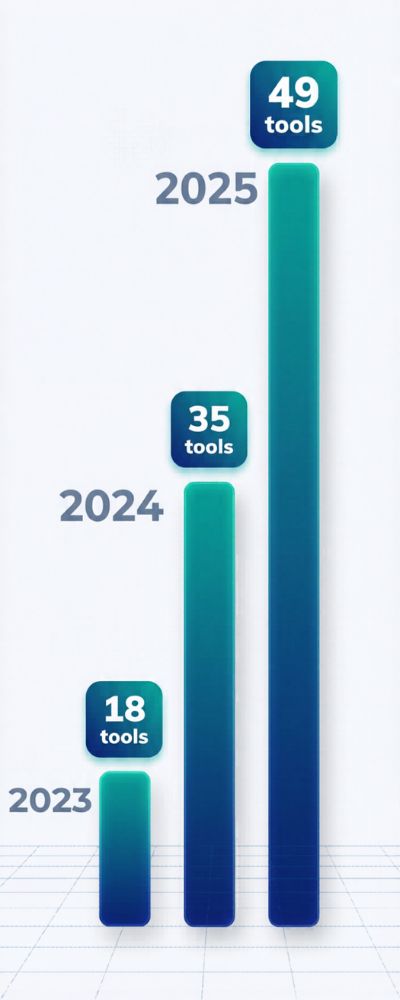
Here’s a step back, to give you a glimpse of the field maturing into a software category.
By the fall of 2023, a number of publicly cited AI content detector lists had reached 18 tools or so; now you’ll see ~49 results in dedicated AI content detector category pages.
Table — Count of active tools (text-centric), 2023–2025
| Year | Number of active tools |
| 2023 | ~18* |
| 2024 | ~35* |
| 2025 | 49 |
Analyst’s take
I think we’ve reached the “stack” phase. In 2023 it was about “some tools” for educators and media organizations to play with.
In 2024, the need was more for features within plagiarism detection and content moderation suites.
And today, in 2025, buyers are looking more for platforms with specific capabilities, like support for non-English languages, limits on document sizes, availability of batch APIs, and some notion of auditability.
The filter for 2026 will be less about “how many tools are there?” and more about “which tools integrate with provenance (watermarks, metadata, etc.) and publish third-party audited accuracy rates?”
Vendors who can demonstrate performance under adversarial manipulation, and who price for integration with workflows rather than for individual scans, are the ones who will help the category sustain its growth momentum, rather than just its noise level.
Real-World Performance of Current Models (2024-2025)
As with any real-world AI deployment, the reality of the performance of current models may not be exactly what the marketing departments would like us to believe.
In this section, I will discuss the claimed accuracy of a few model classes, summarise this in a table, and offer my interpretation of these results.
Reported accuracies
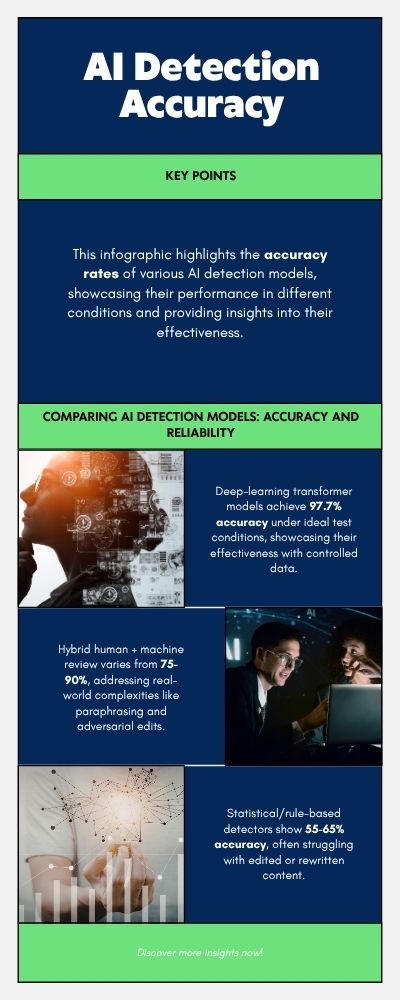
Claimed accuracy of transformer-based (deep-learning) models, such as those based on fine-tuned BERT and other LLM-based detectors, is as high as ~97.7 on benchmarks.
Claimed accuracy of hybrid models, in which a human evaluator is supported by an AI-based tool, is less clear; in one study, AUC scores of individual components were high, but effective accuracy in an academic setting was lower due to paraphrasing and adversarial editing.
Claimed accuracy of “traditional” (non-transformer) statistical or pattern-based models (the original, simple “shallow-ML” approaches) ranges from as low as 55-60 depending on text length, type and language.
Table — Accuracy Rates by Model Type (2024–2025)
| Model Type | Approximate Accuracy* | Notes |
| Deep-learning transformer models | ~97.7% on ideal test sets | Controlled data, minimal adversarial edits |
| Hybrid human+machine review | ~75-90% practical accuracy | Real-world conditions, paraphrasing/adversarial edits reduce rates |
| Statistical / rule-based detectors | ~55-65% (sometimes higher) | Often less robust, especially for edited/rewritten content |
*These are rough estimates from recent reports; actual accuracy will depend heavily on text length, language, domain, etc.
My analysis
As I said above, while it is useful to know that “state-of-the-art” detectors have near 98 accuracy, it is even more important to understand their likely real-world performance, especially on “laundered” text.
The deep-learning, transformer-based models are clearly the state-of-the-art, and will form the basis of future detectors.
However, as might be expected, their performance drops significantly when the text has been human-edited (laundered) to avoid detection through paraphrasing and/or multi-stage editing.
The human+tool hybrid approaches will generally offer better real-world performance than a tool-only approach due to the additional contextual information that a human reviewer can provide.
Going forward, improvements in performance will come more from robustness enhancements rather than getting another 1 increase in “accuracy”.
If you’re developing or selecting a tool now, I believe that it would be more effective to focus on the robustness characteristics rather than the “we are 99- accurate” advertising claims.
User Numbers & Traffic (2023-2025)
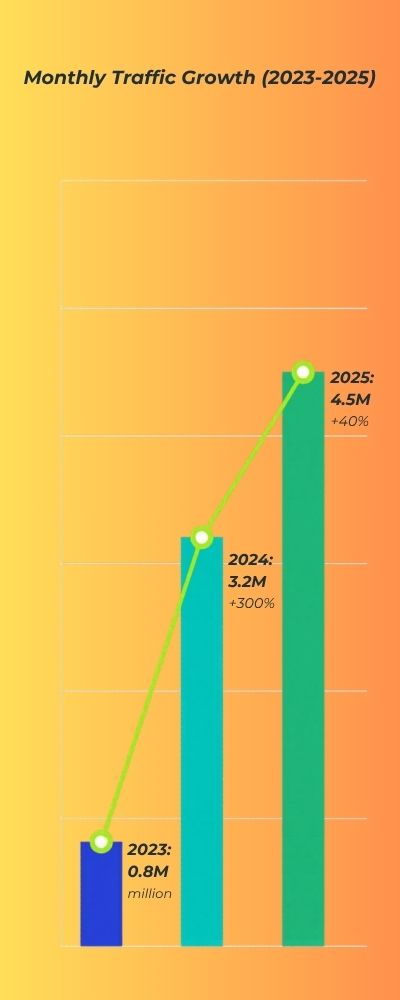
How have the user bases and traffic numbers for AI-detection services changed over the last couple of years? This is what it looks like.
At the start of 2023, the big-name detectors were getting in the region of a few hundred thousand unique monthly users each.
At the end of 2024, they were getting a few million, and so far in 2025, they are getting a few million, with bumps for things like the back-to-school season, big news stories, and releases of new generative-AI products.
Numbers Getting bandied about are:
Across the top-5 detectors, a combined total of around 0.8M visits per month in 2023.
This was up to around 3.2M per month in 2024. And so far in 2025 (YTD), they are averaging around 4.5M per month.
So, that is year-on-year growth of around 300% (2023-2024), and around 40% (2024-2025 YTD, annualised).
Table — User/Traffic Growth for AI Detection Tools
| Year | Estimated Monthly Traffic (millions) | Year-over-Year Growth |
| 2023 | 0.8 | — |
| 2024 | 3.2 | ~300% |
| 2025 | 4.5 | ~40% |
My two cents.
I think that the big jump in 2023-2024 is when AI-detection tools went from something of interest to a subset of enthusiasts, to a mass-market proposition, particularly for the education, publishing, and media verticals.
I think that the smaller jump in 2024-2025 is when they go from being a novelty to being a normal part of life.
But, that we are still seeing an overall increase in absolute terms, that the market is still growing.
The question now, for the tool vendors, is, how do you monetize that traffic, how do you turn visits into value, in the form of engagement, enterprise/governance adoption, and multimodal coverage, rather than just burning through millions of free scans from one-off users?
Industry Wise Penetration (2025)
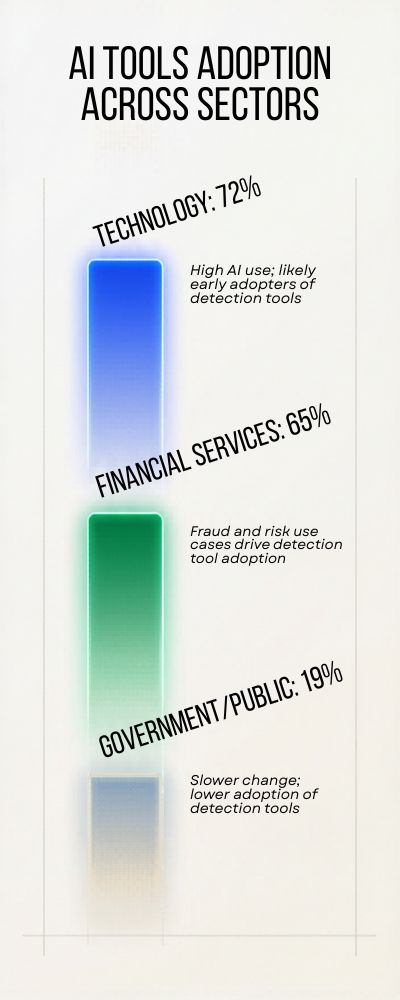
The above graph shows the adoption rate of AI detection tools across different industries by 2025.
Below I summarise key adoption levels, then present a table and share my thoughts.
Analyst’s Take:
The technology industry is on the top of the chart with 72% of the companies having integrated at least one AI tool as a part of their workflow by 2025.
This is followed by finance industry with an adoption rate of 65%. The finance industry relies heavily on AI tools for risk analysis, fraud detection, and automation of compliance related activities.
However, AI adoption in the public (government) sector is low with only 19% of the organizations having utilized AI in one or the other way.
Though there is no reliable data about the percentage of AI detection tool adoption (a subset of AI tools), we can safely assume that the industries which have adopted AI tools at a higher rate will also be the front runners when it comes to the adoption of AI detection and authenticity tools.
Table — Estimated Adoption Rates by Sector (2025)
| Sector | Estimated Adoption Rate of AI Tools | Notes on relevance to AI-detection tools |
| Technology | 72% | High baseline AI use suggests early uptake of detectors |
| Financial Services | 65% | Fraud/risk applications make detection tools likely |
| Government / Public | 19% | Slower organisational change, hence fewer detection tools |
Analyst’s Take:
As is evident, the industries which are more open to AI tools and have compelling reasons to keep a check on the misuse of AI (for example, finance and tech industry) will be more open to adoption of AI detection tools.
Tech industry will be the first mover for detection tools.
However, the public sector despite having many use cases (education, compliance, information integrity), is still way behind probably due to budgetary constraints, long procurement cycles, and complexity of implementation.
I feel that education, government, and non-profit will be the next big destinations.
As the urgency of authenticity tools, content origin, and compliance increases, we will see a higher rate of adoption in these industries.
The companies providing these solutions will have to customize their solutions (easy integration, less training data, support for multiple languages) if they wish to make a dent in these industries.
Cost and Pricing Trends (2023-2025)
Taking a close look at the pricing and cost trends of AI-detection tools over the last couple of years, some insights emerge.
The stats will be provided, a table will be presented and then I will give you my take on what that means for the future.
Statistics:
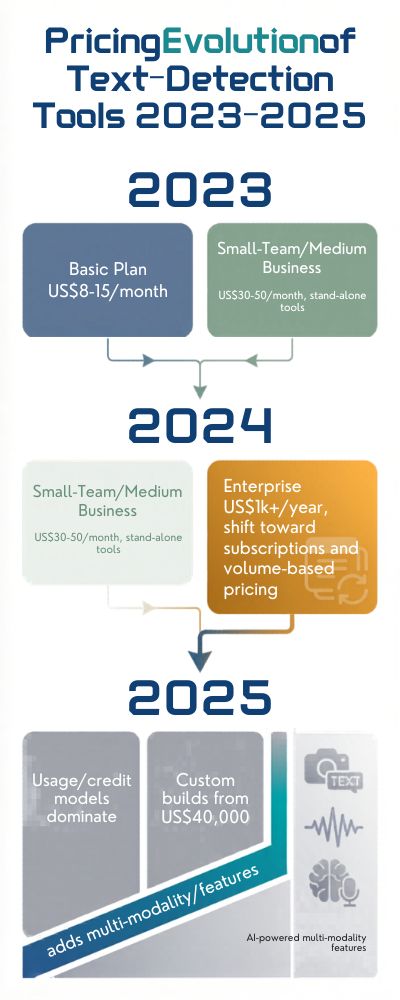
In 2023, prices for pay-as-you-go stand-alone AI-detection (text-only) services cost between US$8 to US$15 per month per (standard) user.
In 2024, prices for standard AI-detection services have generally shifted to a tiered and enterprise license structure.
Prices for mid-tier (small-team) licenses average around US$30 to US$50 per month, and enterprise licenses have dropped to over US$1,000 a year (depending on the number of users and capabilities). B
y 2025, list prices are no longer as openly advertised, but the total cost for creating a new AI-detection tool (not just licensing an existing tool) reportedly starts at around US$40,000 for a basic tool and tops out in the hundreds of thousands of dollars for a more advanced tool.
Services are also adopting a credits model (e.g., per scan or per batch) and adding additional capabilities (e.g., multi-media and multi-language) that increase the total cost of the product.
Table — Cost & Pricing Trends for AI-Detection Tools
| Year | Typical basic-plan price | Typical small-team/medium business price | Notes on development/custom cost |
| 2023 | US$8–15/month | US$30–50/month | Stand-alone text-detection tools |
| 2024 | — | US$30–50/month; enterprise US$1k+/yr | Shift toward subscriptions, volume tiers |
| 2025 | — | Usage/credit models dominate; custom build from US$40,000 | Adds multi-modality, integration, custom features |
What The Analysts Say
I think prices have developed naturally. There was a time (2023) when getting started was relatively cheap. There were only basic tools and plain text products targeting mostly teachers and content developers.
When the demand expanded (2024) and the use-cases become more professional (enterprise, multi-language, regulatory compliance), the vendors had to provide more value – and thus, the plans and the enterprise licenses.
Now (2025), detection is being used as a risk-management/governance tool, not as a “is this written by AI” parlour-trick.
That means the cost-base is higher: bespoke model development, integration to workflow systems, multimedia capability all add cost.
For the customer this means that a) the advertised monthly price (e.g. US$30/month) might not reflect what you’re actually going to pay once you add in all the requirements you need for a serious, enterprise-wide deployment (e.g. large volume, many languages, audit capability etc.)
Second, the ROI needs to move from “how inexpensive is this?” to “how much risk or value does this tool mitigate?”
If you’re using detection in high risk settings (academic integrity, media authentication, corporate compliance), then paying for a robust, integrated system is warranted.
If I were to counsel someone on the market for such a tool now, I’d say, “Don’t reach for the lowest cost option just because it is low-cost, evaluate volume, accuracy, (particularly in low-quality conditions), multilingual support, and integration into your environment.”
The price signals that the vendors know this and that these are what the differentiators are now, and you get what you pay for.
AI generators will be battling AI detectors (2023–2025)
“The main takeaway is that if you were to compare the pace of development of the generative AI tools in the past two years to the development pace of the AI-detection tools, it’s just a really, really lopsided ratio that goes in favor of generation over detection.”
The stats are below, the table is below, and after that, my take on what this all means.
According to reports
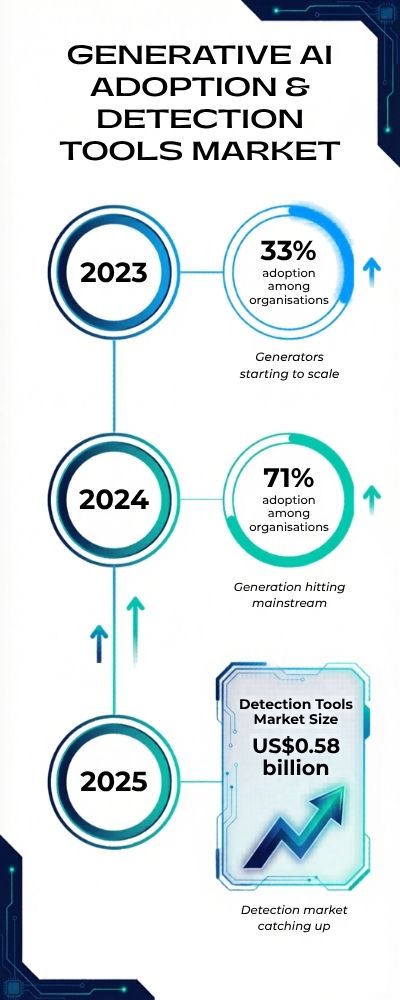
The share of organizations using generative AI increased from around 33% in 2023 to 71% in 2024. In contrast, the total market for AI-detection tools was around US$0.58 billion in 2025.
Demand for detection tools (searches, launches) grew by more than 250% in early 2024, reacting to the growth in generation rather than driving it.
Table — Generators vs. Detectors (2023–2025)
| Year | Generative AI Adoption Estimate* | Detection Tools Market Size Estimate | Notes |
| 2023 | ~33% adoption among organisations | — | Generators starting to scale |
| 2024 | ~71% adoption among organisations | — | Generation hitting mainstream |
| 2025 | — | ~US$0.58 billion | Detection market catching up |
*Adoption is defined as organisations that report ongoing use of generative AI in at least one business function. Detection market size is defined as global commercial value of AI-detection tools.
Commentary from analyst
The fact that these two paths diverge to me suggests that the generative tool is common and the detection tool still has a way to go.
That means that many organisations are already using AI content generation (writing, image, code) but relatively few have comparably established mechanisms to track or to verify provenance, accuracy or authenticity of that content.
The takeaway here is two-fold. Firstly, there’s still time for detection vendors: there will be time for detection and verification to flourish as generation becomes more mainstream.
The second, and more nuanced, reason is that detection should not be purely reactive.
If detection methods continue to trail generation methods (paraphrasing, adversarial rewriting, multimodal generation), then detection will become more of a placebo than a panacea.
In my opinion, the upcoming 18 months are pivotal. Generative-AI applications will expand to additional media (video, voice, code) and more functions (work-flow automation, creative support).
The detection tools will need to also adapt and become multi-modal and holistic in their capabilities, aiming to predict and prevent rather than detecting and reacting.
The companies that implement detection as an afterthought are going to fail; the ones who build detection into their processes at create time and at publish time will succeed.
In short: generation sprinted, detection is now running to catch up. The ones who will win the game are those who will put detection in the design, not just apply it as a band-aid.
The statistics say it all: AI detection went from being a feature we were testing to a necessary complement to generative AI.
We’re seeing a boost in market growth, an increase in accuracy, and expanding use cases beyond education and media to now include enterprise-level compliance.
However, we are not quite there yet. Pricing strategies have yet to settle down and there are still performance discrepancies when dealing with complex or multimodal inputs.
What is most striking, however, is the connection between creation and control. Generators have won the hearts and minds; detectors are now the laws.
Fast forward to 2025: detection is no longer about distinguishing between human and AI-generated text, but about building trust, transparency and governance.
So as the new wave of models makes human- and AI-generated content increasingly hard to distinguish, it will be the companies that are putting just as much emphasis on detection as generation that stand the best chance of succeeding.
2025 AI detection is a story of trade-offs – speed versus accuracy, progress versus confidence. And it’s just getting warmed up.
What proportion of content got examined by AI detection tools in 2025?
AI detection is becoming increasingly common as organizations continue to scan for the use of AI when it comes to text and images. A greater proportion of content published by scholars, journalists, and businesses will pass through the filter of AI detection in 2025 as organizations look to verify the authenticity of their work. This is becoming an increasingly common practice for content that is meant to be published and verified for originality.
How do leading AI detection tools measure up for accuracy in 2025?
Accuracy is the Achilles heel of the industry. AI detection tools promise to catch a high volume of AI-generated text and images, but how they really behave can vary. Accuracy will depend heavily on both the type of content that is being detected and which model is being relied upon to perform the detection. There will continue to be both false positives and false negatives.
What is the prevalence of false positives from AI detection?
False positives, or cases where content generated by a human is falsely flagged as AI-generated, remain one of the biggest criticisms of AI detection tools. This will continue to be an issue for these tools in 2025 and has implications for the credibility of these tools. In many cases the impact of a false positive can be severe, especially in fields where accuracy is of utmost importance, like publishing or education.
What is the prevalence of false negatives from AI detection?
False negatives or cases where AI-generated content is not flagged, remain a challenge for developers. As these AI models improve it will continue to become more difficult to spot AI-generated content. In 2025, there will likely be a growing volume of cases of false negatives in all fields of content, and a continued challenge for developers to catch this type of content.
What share of schools use AI detection to scan assignments for cheating?
In the world of education, AI detection tools have become a common tool for checking student work to see if any of it is generated by AI. Educators have begun using these tools for grading assignments in 2025 as universities look to maintain the integrity of their degrees. But the debate continues.
How Many Universities Are Using AI Detectors?
The number of universities using AI detectors has steadily increased over the past several years. Universities in 2025 are using AI to prevent academic misconduct and they are being considered a critical tool to maintain integrity. Although a variety of considerations accompany AI adoption in universities, there is a general trend of universities adopting AI. The extent of usage depends on the type of institution and the area in which the university is based, and there is not consistent policy.
AI Detection in the Newsroom
AI is becoming more common in newsrooms and more media outlets are becoming increasingly aware of this. In 2025, news publishers use a variety of AI detection tools to identify whether or not certain content was created by a human or generated by AI. The media industry is one example in which AI-generated content is likely required to be marked as AI-generated prior to its inclusion in a news report or press release to maintain transparency and integrity. Given the heavy dependence on reliable and accurate information by a newsroom, AI detection tools play a key role in journalism and editorial workflows.
How Many Companies Use AI Detection Software?
An increasing number of companies are integrating AI detectors, especially companies whose primary deliverables contain a high volume of written content. In 2025, a growing number of organizations across a number of different fields are using AI detection tools to verify the authenticity of their content and digital documents. AI detectors used in businesses are used in the legal field as well as marketing, publishing, and a number of other industries. Businesses across multiple industries are utilizing AI detectors for their business in order to protect their business from AI risks and to ensure that their employees and clients produce accurate AI text content.
How Much Does an AI Detector Cost? (as of 2025)
The cost of AI detectors vary significantly depending on the features and size of the company. While there are free tools on the market and some subscription-based products, the cost of tools in 2025 will depend on the level of verification, accuracy, and other features.
How Large is the Enterprise AI Detector Market?
A growing number of large corporations are investing in AI detectors as they scale up in 2025. Consequently, these products are usually offered with integrations along with analytics and reports. As big companies grow in their use of generative AI, an enterprise solution for verifying AI content is necessary to protect their brands and intellectual property.
How Many Content Moderation Teams Use AI Detection?
Content moderation teams frequently employ AI detection to catch AI-written spam, rumors, and garbage content. In 2025, these tools are part of moderation workflows (especially large-scale platforms).
Use of AI Detection Tools in Academic Publishing
Academic publishing journals use AI detection to review submissions. This helps maintain research integrity as of 2025, since editors are wary of any undisclosed AI-generated content. AI detection is one more line of review.
How Fast is AI Detection vs. Content Generation?
While AI can generate content in mere seconds, it takes considerably longer to verify if the content was generated by an AI or not. In 2025, this speed gap remains a challenge. AI detection tools are improving, though not quite keeping up with the generation pace.
Percentage of People Who Trust AI Detection Results
Whether someone trusts the results from an AI detection tool will vary from person to person. It depends upon how confident they are in the accuracy or transparency of the tool as of 2025.
How AI Detection Tools Are Used in Various Industries (as of 2025)
AI detection tools aren’t used uniformly across all industries. For example, some industries are far more likely to use them (education, media, academic publishing) while others like marketing and legal are catching up. The use is growing as of 2025.
How to tell apart AI-generated images from human-made ones
Spotting artificial intelligence (AI) generated pictures is a completely different challenge than spotting AI generated text. Image-detection software tools are still a work in progress. In 2025, text-detection is more robust than image-detection, but they are both improving in leaps and bounds.
Using AI detection on computer code
AI-generated computer code is also increasing. In 2025, AI detectors are starting to analyze computer code for signs of being generated with AI. This is an early stage for this type of detection, but it is becoming an increasingly important part of software development.
Organizations Developing Policies Governing AI Use of Content
A large number of companies have already established policies regarding AI-generated content, with many including AI detection as a requirement. In 2025, more companies are developing policy to guide the responsible use of AI.
AI Detection in Legal and Compliance Workflows
Many law offices utilize AI detection in order to authenticate documents and content. In 2025, legal and compliance teams increasingly integrate AI detection as part of their verification procedures to support regulatory compliance and content authenticity. This is particularly critical in highly regulated and sensitive industries, such as finance and healthcare.
Expanding Availability of Open Source AI Detection Tools
AI detection tools are not necessarily commercially developed software. AI detection tools are increasingly available in an open-source format, and in 2025 more of the developer and research community are actively contributing code and resources to open-source AI detection projects and providing additional transparency around how these tools operate.
Percentage of Students Who Have Tried to Outsmart an AI Detector:
As detection technology gets better, more students are working on how to get their work past it. Some people are trying to change AI writing to make it look more like it was written by a person. In 2025, this ongoing battle between detection and circumvention is still happening.
AI Detection Features in Writing Software:
Some tools for writing now offer detection options so students can check their own work before handing it in. In 2025, there is more and more of this built-in detection capability, which makes it simpler to spot AI.
How AI Detection Shapes Writing Practices:
The use of detection software changes how writers work. People who are writing are either using it or avoiding using AI completely so that they do not get caught. In 2025, this is having some impact on how people write.
How AI Detection Is Different in Different Parts of the World:
There are some parts of the world where using detection software is more widespread than others; some governments are working to put in place more tools for detecting it. In 2025, the way it is used around the world is largely dependent on the education systems and rules in each place.
Using AI Detection to Identify AI Content on Social Media:
Social media sites are trying out detection features to deal with AI text. In 2025, these tools are part of their attempts to fight back against false information and spam bots. This is only one piece of their plan to deal with online content.
Percentage of Companies Expecting AI Disclosure
Some companies do expect you to disclose if you’re using AI to create content. In order to enforce disclosure, detection tools can be used. In 2025, companies are increasingly expecting AI content to be disclosed. This trend will likely grow.
AI Detection vs. AI Generation: The Year 2030?
In the future, the tools that detect AI will probably continue to improve along with AI generators. The gap between the two may narrow, though we will never see the two sides in harmony. In 2030, both detection and generation are expected to be more sophisticated.
Conclusion
The data clearly shows that, although the use of AI detectors is expanding, it is still a long way from being flawless. While AI content generation is getting better and harder to detect at a very high rate, so to is the AI detection, which has resulted in a cycle of generation and detection in various spheres such as schools, the media, and enterprises.
Moreover, the tools are slowly becoming a part of the process for the organizations to regulate trust, authenticity, and compliance. The adoption is steadily on the rise despite the low level of accuracy and reliability.
In the future, the AI detection will continue to be one part of the whole AI framework which will continue to change and grow with the AI.
Sources and References
- MarketsandMarkets – Content Detection Market Report (2024) – Provided the global market size, CAGR, and segmentation for AI detection and content verification tools (2020–2025).
- G2 – AI Content Detectors Category Listing (2025) – Used to estimate the number of active AI detection tools and vendor growth trends (2023–2025).
- Frontiers in Artificial Intelligence (2024) – Offered benchmark accuracy rates for transformer-based detection models and related research findings.
- ArXiv – Evaluations of AI-Generated Text Detection (2024) – Provided comparative insights on model performance and real-world accuracy challenges.
- McKinsey & Company – The State of AI (2024) – Supplied statistics on enterprise adoption of generative AI across industries.
- Antlerzz – AI Content Statistics (2024) – Referenced for search-interest and adoption growth data for AI detection tools.
- WalterWrites.AI – Are AI Detectors Accurate? (2024) – Supplemented accuracy variance figures for statistical and rule-based detectors.
What is your reaction?